Showing posts with label psychology. Show all posts

Thursday, April 19, 2007

Cultural Illusions

It was not my intention to write about illusions that much, but you know teachers, they love to explain. So illusions again, simply to answer the question what I consider to be cultural illusions.
Let me show you an example:

Of course, we all see a zebra, that is not the illusion. The question is what do you perceive from a zebra? Apparently most white people see a white animal with black stripes, whihttp://www2.blogger.com/img/gl.link.gifle most black africans see a black animal with white stripes.
I guess the next picture (from the University of Bergamo) is cultural free?

By the way, in search of information about the use of post-its for user testing I found a link to an article about its use for brainstorming, but also a link to a "proper zebra-crossing":
http://hiddenchemistry.com/proper-zebra-crossings/

I am not so very sure that foregoing example is a real cultural illusion, but the next is. Look at these stairs:

Again, the illusion is not whether these are stairs or not, but how do you perceive them. Are they going up? Or are they going down?
Apparently most Europeans and Americans perceive these stairs as 'going up', while people from countries where the direction for reading is from right to left look upon these stairs as going down.

It makes me wonder if the same goes for the next stairs:

Are these stairs going up or going down? Based upon what?

Let me finish with the most interesting stairs, several illusions appear together here:

If you want to know more about it, read the accompanying article: http://www.quantonics.com/Stairs_As_Perceived_by_Our_Quantum_Stages.html

Saturday, April 14, 2007

Tunnel-vision

Tunnel-vision is a proces where clues seem to lead us in a certain direction, whereafter following information seems to justify our presumption.
The first time I heard about it, was concerning an investigation by the police, where the investigating officers jumped to a conclusion in the first stages of an ongoing investigation. Thereupon all clues that conflicted with their conclusion were ignored (to be "of no importance" of "inconclusive") while clues that reinforced their idea were accentuated.
And yes, an innocent men was sent to prison for over 10 years....
Recently I came across the same problem with two students working on their final project. In an early stage they had a good brainwave, got a good idea (and the idea still is), but in the following research they just looked at facts that supported their initial design, while ignoring conflicting facts. And that is just no the right way a research should be executed. (And right so, because in their subsequent research they did find reasons to alter their original design, so came up with a better product in the end!)
And now we, apparently we fall for the same trap. Consider the following pictures:


Do you see any parallel lines? In the upper picture it is evident, but what about the lower? No? Neither do I. Nevertheless the horizontal line are parallel, although you can't see so. (Don't believe me, check!)

This was first discovered during the redecoration of a pub in Bristol, the owner decided that he like black and white tile alternating on the outside of his pub. The tiles were to be set in stretching bond (each tile is placed with its center on top of the border between two tiles). When the decoration was finished, it didn't please the owner, of course, it was not what he intended. Nowadays the pub is famous all over the world because of its outside tiles.

For an explanation of the effect, read the article from Bristol.

Speaking of a tunnel


When you see the spirals, you realise that you can go deeper and deeper. Unfortunately you jumped to the conclusion that it are spirals that you see. I suggest you follow the cirkels with your finger to be absolutely sure. There really is no tunnel to go into. But at least now you know why it is called tunnel-vision!.

Illusions - I

Perception seems to be a key-item for me. When our mind plays tricks with us, we call that illusion. Several types of illusions do exist. We may encounter verbal illusions, visual illusions, cultural illusions (hmm, aren't they all, maybe I should look into that) a.s.o.

Illusions are as old as mankind. Wellknown examples as "Trompe d'oeil" (yes, there should be a link here, hmm, maybe when I find more time. For now just google yourself).


Very intriguing is what is called the "Hollow Face - illusion", several examples exist, which I will lead you to. Look at the accompanying picture, the little paper dragon. When you do not know what is the matter, you don't see anything unusual. Let's illustrate this with two movies:

1. The Hollow Face - illusion, face of Richard Gregory.

2. Charlie Chaplin - Hollow Face - illusion

This is all about assumption & perception. We know what we see, but our minds are unwilling to accept what it is that we see, so they create our own reality, and we are most happy with it. Try to stay happy when you look out your window and realise this is what we do every day.

For years I was very interested in virtual reality, only to find out, that reality already was quite virtual as it is. The same goes for 3-D objects. Some of us spend a lot of time creating them (not me, I'm just too lazy, although I did try some ray-tracing, years & years back). And always they are trying to create a type of reality that just waits to be rebuild in our heads.

Consider the next picture, especially tiles 'A' and 'B':


Myself, I was very intrigued by the fact that both surfaces have the same color. I mean, you don't SEE the same color! There are several ways to prove that they indeed have the same color. Use a colorpicker to check on the colors (I didn't want to believe it, so I did), or better view the movie:
http://web.mit.edu/persci/gaz/gaz-teaching/flash/plaid-movie.swf

Here, again, it is our assumption that creates the illusion, our minds 'enhance' the effect, by trying to create the picture that would be responsible for what we actually see. If those tiles look the same, than they should be a different color, because the upper one is in the light, while the lower surface is in the dark. If they're the same, they must be different!

We will encounter more of this in the future, because our minds keep on tricking us for all the right reasons, but in all different kind of ways. For now I leave you with the next example, where 'A' and 'B' again have the same color.

(so, for people who think I am quite grey: are you sure it's not just only in your mind?):-)

More from Richard Gregory:
http://www.richardgregory.org/experiments/index.htm

Want to make your own little dragon?
http://www.grand-illusions.com/opticalillusions/dragon_illusion/
http://www.pontomidia.com.br/ricardo/greatweb/gathering_for_gardner_paper_dragon.html
Not just dragons, a skeleton too:
http://ravensblight.com/Illusion.html

Wednesday, April 11, 2007

Perception

Perception again, yes. Like I said, I think it is an interesting subject. Consider the following item:
We have four frigidaires, all of them are white.
Now answer the following questions:
What is the colour of the first frigidaire? ...
Yes, that is correct.
What is the colour of the second frigidaire? ...
Indeed, that is correct again.
Now can you tell me the colour of the third frigidaire? ...
Well, correct again. We're nearly there.
Tell me, what is the colour of the fourth frigidaire? ...
Correct, that was easy.
Now tell me, what does a cow drink? ...

Okay, if you say so....

I am not sure as how this works written as well, but if it didn't then try it with somebody. Just ask the questions, wait for the answer, then ask the next question.
This is an example of "priming".

Another example, answer the next questions:
"May a woman marry the friend of her daughter?" ... "May a man marry the mother of his sister?" ... "May a man marry the sister of his widow?" ...
Guesses are that about eighty percent of the people will say 'yes' to the last question. The right answer, of course, should be 'no'.
(If you don't see it, ask yourself: what does 'widow' say about him?).

It is interesting to see what goes wrong here. Apparently our minds get set on a track and then it is difficult to change. It illustrates that we only use a part of the information that we get.
But even if we only use a part of all the available information things can go wrong. Read the following words:
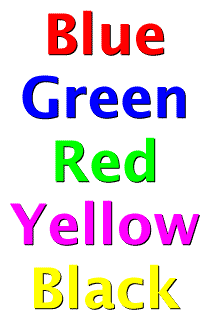
That was not too hard, was it? Just a few names of colors. Piece of cake.
Now look again, but now do not read the names, but name the colors you actually see, the colors of the words.
Maybe still a piece of cake, but quite a different cake, is it not? It should not be too hard, but it is.

This is an example of conflicting information. It should not be any problem if the words were f.e. Icelandic, or in Japanese characters (unless you were from Iceland, resp. Japan, of course). Young children who still have to learn to read, but already know their colors do not see any problem.
We get two sets of information: (1) the color and (2) the text. When those two match there is no problem, but when they don't...
This effect is called "the Stroop-effect", named after Dr. John Ridley Stroop who did describe the effect first in 1935.

Want to try some more 'stroop'?
go http://www.dcity.org/braingames/stroop/
When you like those braingames, have a good intuition, and an understanding of statistics I suggest to play the "3-doors game".

More about priming?
Priming: Priming is an acuteness to stimuli because of exposure to a certain event or experience. For example, an individual who has just purchased a new car may now start to notice with more frequency other people driving her same make and model. This person has been primed to recognize more readily a car like hers because of the experience she has driving and owning one.(http://www.alleydog.com/glossary/definition.cfm?term=Priming)
wikipedia
the priming theory
Want to try an experiment?

Tuesday, April 10, 2007

Groningen University Museum

One of my main interests always is perception. We do not see what's there, we see what we see, we percieve. That is true for images (I will write about that soon), but it is also true for text. Look at the following question:
"How many animals of each type did Moses take with him in the arc?"

Usually the answer will be "2 animals of each kind". Apart from problems of biological nature (male & female doesn't count for snails a.o.), the answer should be "none".
None? Yes, because it was not Moses but Noach, that built the arc.....
And no, this is not just a joke I hope you fell for, it is an illustration of the way our mind works. A problem does not have to be complete, there may be some mistake in the information, it is not a problem for us, as illustrated before. We, people, are very good in fuzzy information.
Take a look at the following picture.

You probably recognize the sentence, it is used to introduce you to a new font. It is used because it contains all the letters in the alphabet. Why I did put it here?
Well, did you notice anything wrong? Maybe you did, but you probably did not.
Read the sentence. Say the sentence. Say the sentence again, now without looking at the picture. Still without looking at it, count the number of words in the sentence.
Now look at the picture and count the words again. Notice anything strange?

This is what our mind does. It perceives. It perceives what it thinks is meant, and all 'ballast' is filtered out. More examples are available at the "Groninger Universiteitsmuseum". When you are in (or near) Groningen, I recommend a visit. It is almost free, it is very interesting (it helps if you understand Dutch), and it is Oude Kijk in 't Jatstraat 7a.

UNIVERSITEITSMUSEUM
Oude Kijk in 't Jatstraat 7a
9712 EA Groningen
tel. 050-3635083/3635562
Tuesday to sunday, 13.00 - 17.00
until May 13

Groninger Universiteitsmuseum
Bent u een goed verstaander?

Saturday, March 31, 2007

Emotional or Rational?

Making decisions is hard? For most people it is, for some it even is hard to overcome. Since the weather just has gone sunny, you may find yourself standing in line for an ice-cream, in front of you a whole family trying to decide whether they shall take chocolat, banana-vanille or "boerenjongens" (literaly: Country boys, in this case: icecream with brandied raisins). They were even trying to be rational about it (if we all take chocolat, then little... aso)

Unfortunately, people are not very good in rational decisions for everyday use. We tend to trust our mental models (and we should!) and make emotional decisions. This is smart, because usually we do not have time to make a rational decision ("if I take a Papsi Max instead then it is low on sugar, but a Cherry-coke... Oh, no, I am late for class... Or shall I take a Rivella instead? It is also low in sugar and it's got this extraordinary taste, but maybe I should take a drink without bubbles, because that's gonna make me feel... Oh hell, I'll just have a black coffee. Oh, wait, there's also Wiener Melange in the new machine, I haven't tried it yet," aso aso).

Imagine this while driving a car? With another car driving towards you? (No, you're not playing chicken, you're trying to get the kid to school, to be in time for your work, and trying to decide what to eat tonight.) If you start thinking rational about the car in front of you, you may never know what you will eat tonight. You just don't have the time.
Suppose I have a long rope, from one building to another, say 10 meters up in the air (I had some left from my kid's kite), and I would ask you to test its strength by hanging at it.
You would say "no". (And that's probably why I won't ask you).

Is this a rational decision?

No, it isn't. You didn't take time to think about. You didn't need to, but therefor it is an emotional decision. Just be glad we are good at emotional decisions.

SMART!

This is terrible! Somehow I will have to find a way to make time to continue writing. Collecting drafts doesn't do any good (there is one on paper prototyping that I just don't seem to get finished)
TU Delft (Delft University of Technology) has found a way to make an accelerator pedal smarter! The way this is done is very nice. The driver gets feedback according to the distance to the vehicle ahead. But it does not provide a regular warning signal (the annoying blinking light or just as annoying beep), it just makes the pedal harder to press if you are too close.
Since people are very good in avoiding annoying signals (who still notices the annoying ads while surfing? Do you ever click them?), this is so smart. It doesn't take over (how annoying is that!), but it does help you to take notice in a non-obtrusive way.

Link to TU Delft (English)
Link naar TU Delft (Nederlands)
Direct link to the article

Monday, March 26, 2007

Perceptie

Zou iemand mayonaise lusten die legergroen van kleur is? Wat zou onze perceptie zijn? Bedorven? Of gewoon 'vreeeselijk'?
Hmmm, hoe krijg je iemand dan tot het eten van legergroene mayonaise?
Is eenvoudiger dan het lijkt, je geeft het gewoon een andere naam, dressing bijvoorbeeld.....
(dank Wouter Klootwijk)